
OKX Guides
OKX Futures Fees: Perpetual Trading Costs and Break-Even Calculation
Looking up OKX futures fees? Calculate opening and closing fees, funding, slippage, and the price move needed to break even on a perpetual position.
Last checked: August 9, 2026. This independent educational guide is not investment advice. Perpetual swaps are leveraged derivatives and may not be available in every region. Always use the rates, funding interval, and contract details shown in your own OKX account before trading.
Looking up OKX futures fees? Perpetual swap costs are easy to underestimate because the number shown next to a single fill is not the whole cost of a trade. A complete estimate needs the opening fee, the closing fee, any funding paid or received while the position is open, and an allowance for spread or slippage. This guide gives you a reusable calculation you can run before placing an order.
OKX futures fees: the short answer
For a USDT-margined perpetual position, start with this planning formula:
Estimated round-trip cost = opening trading fee + closing trading fee + net funding paid + estimated slippage
Then convert that cost into a break-even price move:
Approximate break-even move (%) = estimated round-trip cost ÷ position notional × 100
This percentage is the approximate favorable price move required before the trade has a positive net result. It is a planning estimate, not the liquidation price shown by the platform. Closing notional changes with the exit price, so an exact result must use the actual fill prices and filled quantities.
Step 1: find your actual maker and taker rates
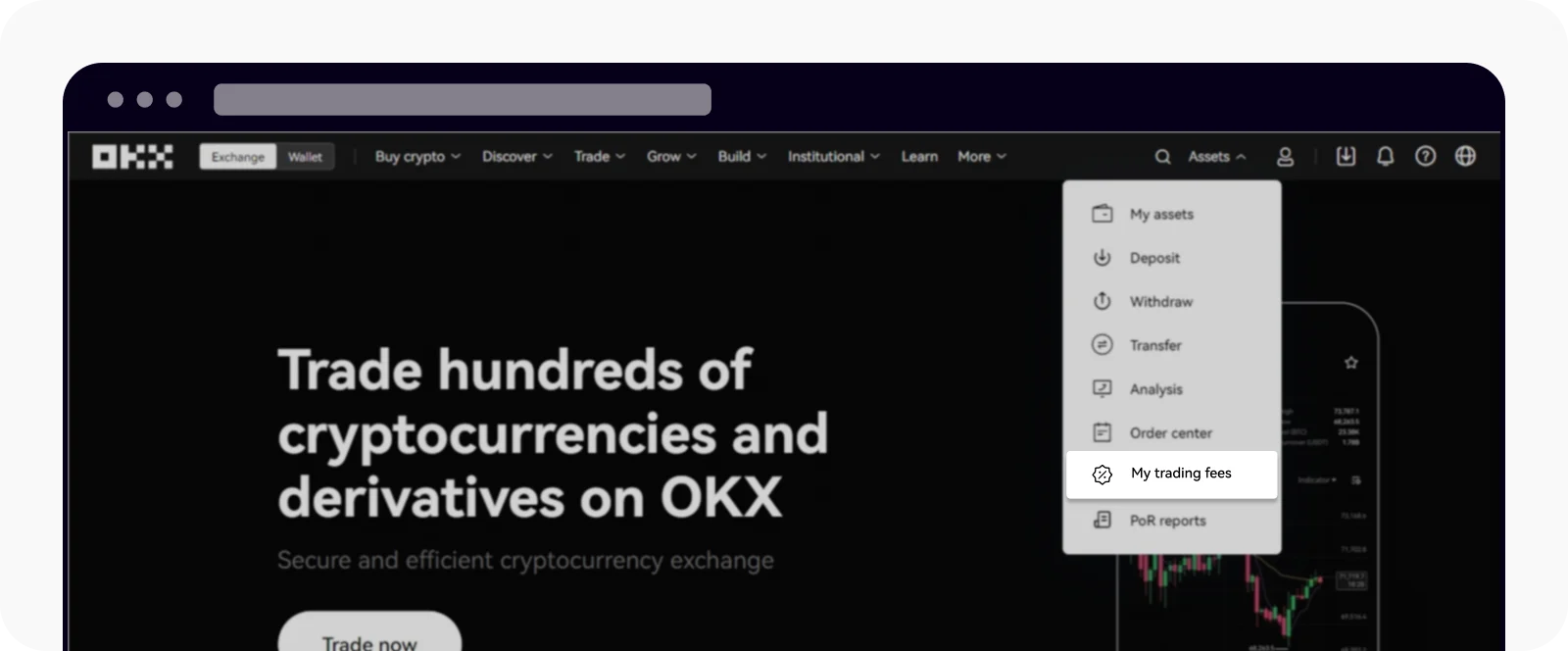
Do not copy a fee rate from a blog, social post, or another trader. OKX says web users can check Assets → My trading fees to see their current tier and the schedule for different instruments and pairs. The order panel also shows the fee rates for the selected pair. Your applicable rate can depend on account tier, instrument, pair, region, and current rules.
A maker order rests on the order book before it fills. A taker order fills immediately against existing liquidity. Maker rates are usually lower, but a limit order is not automatically a maker order: if its price crosses the book and executes immediately, it is a taker order. If this distinction is new, read our beginner guide to limit, market, and stop orders before using leverage.
Step 2: calculate the opening and closing fees
For a USDT-margined perpetual, OKX publishes this structure:
Trading fee = contract value × number of contracts × fill price × fee rate
The multiplication after the fee rate is the filled position value, or notional. In simpler terms:
Trading fee = filled notional × fee rate
Run the calculation twice: once with the opening fill and once with the expected closing fill. OKX states that opening and closing use the same fee logic; the applicable maker or taker rate depends on how each order actually fills. A trade opened as maker can still close as taker. Partially filled orders should be calculated from the executed amount, not the original order size.
Leverage changes the margin you post, but it does not shrink the notional used for the fee calculation. A 10,000 USDT position with 10x leverage may require roughly one-tenth of that amount as initial margin before other requirements, yet its trading fees are still based on the 10,000 USDT notional. This is why fees consume a larger percentage of your margin as leverage rises.
For a broader overview of spot, futures, withdrawals, and fee tiers, see our OKX fee guide.
Step 3: add funding only when the position crosses a settlement
Perpetual swaps have no fixed expiry, so funding payments help keep the contract price close to its reference index. OKX’s formula is:
Funding fee = position value × funding rate
A positive funding rate means longs pay shorts; a negative rate means shorts pay longs. OKX states that it facilitates this transfer between traders rather than retaining the funding payment as a service fee. Treat funding received as a negative cost in your worksheet.
The default assessment times are 00:00, 08:00, and 16:00 UTC, but OKX also supports 1-, 2-, and 4-hour intervals and may adjust frequency with market conditions. You only pay or receive funding if the position is open at the assessment point. Check the contract’s current funding rate, next funding time, and interval rather than assuming every market uses the default schedule.
Do not use the currently displayed funding rate as a guaranteed forecast for several future intervals. Rates change. For planning, model at least three cases: no funding, the current indicated rate for one interval, and a less favorable rate or longer holding period.
Worked example: what price move covers the costs?
The figures below are illustrative assumptions, not a quote of your account’s current rates. Suppose you plan a 10,000 USDT notional long position and assume:
- The opening fills as taker at 0.05%.
- The closing also fills as taker at 0.05%.
- You hold through one funding assessment at +0.01%, so the long pays funding.
- Slippage is excluded at first.
The estimate is:
| Cost item | Calculation | Estimated cost |
|---|---|---|
| Opening fee | 10,000 × 0.05% | 5 USDT |
| Closing fee | 10,000 × 0.05% | 5 USDT |
| One funding payment | 10,000 × 0.01% | 1 USDT |
| Total before slippage | 5 + 5 + 1 | 11 USDT |
The approximate break-even move is 11 ÷ 10,000 = 0.11%. The market therefore needs to move roughly 0.11% in your favor just to cover these assumed costs. If your margin is 1,000 USDT, the same 11 USDT equals 1.1% of the margin even though it is only 0.11% of notional.
Now test the alternatives. If both orders qualify as maker under your actual schedule, replace both rates and recalculate. If you close before the funding assessment completes, remove that funding line. If you expect two assessments, calculate each one with the best estimate available at that time. If the close price is materially different from entry, use the expected closing notional rather than reusing 10,000 USDT.
Step 4: include spread and slippage
Trading fees and funding are visible, but execution cost can still dominate a short-term trade. The bid-ask spread is the gap between the best available buy and sell prices. Slippage is the difference between the price you expected and the average price actually received, often because the order consumes several levels of the book.
Before trading, inspect the order book and estimate the average fill for your intended size. A market order may be appropriate when immediate execution matters, but it removes your control over price. A resting limit order controls price but may not fill. Do not label a transaction “cheap” based on its fee rate alone; our analysis of why a zero-fee OKX pair can still have spread cost explains the same principle in spot markets.
For a conservative worksheet, add a slippage allowance to both entry and exit. If you cannot estimate it from current market depth, reduce the order size or avoid treating the calculated break-even point as reliable.
A pre-trade worksheet you can reuse
Fill in these values from the actual contract and your account:
| Input | Your value | Where to verify |
|---|---|---|
| Position notional | ___ | Order ticket / contract calculator |
| Opening maker or taker rate | ___ | Pair fee display / My trading fees |
| Expected closing rate | ___ | Pair fee display / My trading fees |
| Current funding rate | ___ | Contract information |
| Next funding time and interval | ___ | Contract information |
| Number of funding assessments expected | ___ | Your planned holding window |
| Entry slippage allowance | ___ | Current order-book depth |
| Exit slippage allowance | ___ | Conservative estimate |
Calculate:
- Opening fee = opening notional × opening rate.
- Closing fee = expected closing notional × closing rate.
- Net funding = sum of each expected funding payment; subtract funding you expect to receive.
- Slippage cost = entry allowance + exit allowance.
- Break-even move = total estimated cost ÷ entry notional.
If the expected market move is barely larger than the estimated cost, there is little room for a worse fill, a funding-rate change, or an incorrect assumption. Recalculate whenever position size, order type, holding time, or the displayed rate changes.
Common mistakes
- Counting only the opening fee. Closing is another fill and normally incurs its own fee.
- Dividing the fee by margin instead of notional. Fees are calculated from executed position value; leverage affects how large the result feels relative to your collateral.
- Assuming every limit order is maker. A marketable limit order can execute immediately as taker.
- Multiplying one funding rate by days without checking intervals. Funding frequency and rates can change by contract and market conditions.
- Treating funding as always payable. Its direction depends on the sign of the rate and whether you are long or short.
- Ignoring liquidation-related costs. OKX says forced liquidation fees use the taker rate for the user’s current tier; liquidation also creates far greater risk than an ordinary planned exit.
- Using an old fee table. Verify the current account and pair-specific schedule immediately before placing the order.
Official references
- OKX: How are futures trading fees calculated?
- OKX: Perpetual funding fee mechanism
- OKX: Trading Fee Rules FAQ
These OKX pages note that rules and product availability may differ by customer or region. Use this article as a calculation framework, then replace every assumption with the live values displayed for your own account and contract.