OKX Funding Rate Explained: How It Differs From Trading Fees, and How to Calculate It
Funding and trading fees are easy to conflate but are separate mechanisms. This guide covers who pays whom, the position-value formula for USDT and coin-margined contracts, settlement intervals, and the 2026 formula change.
Published Revised 8 min read
Last checked: August 21, 2026; the settlement schedule section was re-checked against OKX's funding fee mechanism page (Checked on October 13, 2026). Independent educational guide, not investment advice, not affiliated with OKX. This explains OKX's perpetual funding mechanism using OKX's official help centre and public API. Availability, rates, rate caps, and settlement countdowns differ by region and contract — always use the values shown on the contract page itself.
If you searched for OKX fees and ended up reading about funding rates, the two are easy to conflate. They are not the same thing. Trading fees are charged on each fill, based on your maker/taker classification and account tier. Funding is a payment exchanged between long and short holders on a schedule, designed to keep the perpetual contract price tethered to the spot index price.
Understanding funding is not about memorising a percentage. It comes down to three questions: who pays whom, what value is the payment calculated on, and when is the next settlement.
This guide focuses on funding payments on OKX perpetual swaps. To see how it fits with everything else you pay on OKX, start with our OKX fees overview, which covers trading, funding and withdrawal costs in one place.
The one-line version
Per OKX's perpetual funding fee mechanism documentation:
- When the funding rate is positive, longs pay shorts.
- When it is negative, shorts pay longs.
- When it is zero, no funding is exchanged.
- OKX facilitates the transfer between traders; the platform states it does not retain the funding fee.
So a positive funding rate does not mean the market will keep rising, and it does not mean shorting is free money. It tells you the direction of this settlement only. Price movement, trading fees, slippage, and liquidation risk can all be far larger than any funding you receive.
How funding is calculated
The base formula worth remembering:
Funding payment = position value × the funding rate for that settlement
Suppose a USDT-margined perpetual position has a position value of 10,000 USDT at settlement, and the rate for that period is 0.01% (an illustrative figure, not a current rate):
10,000 × 0.01% = 1 USDT
Hold a long while the rate is positive and you pay roughly 1 USDT this settlement; hold a short and the direction reverses.
Position value for USDT/USDC-margined contracts
OKX gives the expression as:
Position value = number of contracts × contract face value × multiplier × mark price
The most common beginner error is multiplying the margin posted by the funding rate. With leverage, your margin might be 1,000 USDT while the notional position is 10,000 USDT. Funding is calculated on position value, not on margin — so the higher your leverage, the larger funding feels relative to your own capital. This is the same trap that applies to contract trading fees; see how to calculate OKX trading fees.
Coin-margined contracts use a different formula
Position value = number of contracts × contract face value × multiplier ÷ mark price
The settlement asset and units may also differ. Do not carry a USDT-margined example over to a coin-margined contract; confirm face value, multiplier, mark price, and settlement currency in the contract specification before trading.
How often it settles
OKX's help centre documents a default settlement every 8 hours, typically at 00:00, 08:00, and 16:00 UTC. Some contracts may settle every 1, 2, or 4 hours instead, and the applicable interval and countdown are shown on the trading page.
OKX also operates an automatic adjustment mechanism: when the rate reaches its cap or floor, the settlement frequency can be stepped through 8, 4, 2, and 1 hour intervals, and may return to the default once conditions normalise. So "three times a day" is not a permanent rule for every contract.
You only pay or receive funding for a period if you still hold the position at that settlement. OKX notes that settlement for a single contract happens within milliseconds, but the overall processing can take up to about a minute. Do not try to dodge a funding payment by closing in the final seconds of the countdown — you may still hit execution delay, slippage, trading fees, or a sudden price move.
Settlement times for each interval (UTC)
| Interval | Settlement times (UTC) | Per day |
|---|---|---|
| 8 hours (default) | 00:00, 08:00, 16:00 | 3 |
| 4 hours | 00:00, 04:00, 08:00, 12:00, 16:00, 20:00 | 6 |
| 2 hours | Every even hour | 12 |
| 1 hour | Every hour | 24 |
OKX says no settlement takes place outside those times. A few details people miss:
- When the interval goes back to normal. If the rate hits its cap or floor at a settlement, the frequency steps up one level at a time (8→4→2→1 hours). It only returns to the default once every settlement over the preceding 12 hours stayed within ±0.20%. Equity, ETF and commodity perpetuals don't use this automatic adjustment.
- Which rate is used. Each settlement uses the rate calculated in the minute before it; the 16:00 settlement uses the 15:59 rate.
- Opening just after the settlement time can still count. OKX's example: processing can take up to about a minute, so a position opened at 00:00:20 UTC may still be included in that settlement. Conversely, if you close before settlement, you neither pay nor receive that period.
- How to see a contract's current interval. The funding rate and countdown sit above the order book on the trading page. Via the API,
nextFundingTimeminusfundingTimefrom/api/v5/public/funding-rategives the current interval; on the day we checked, BTC-USDT perpetual was on 8 hours.
To combine funding with opening and closing fees, work out the trading fees in the fee calculator, then add position value × funding rate × the number of settlements you expect to hold through.
What the 2026 formula change means
In June 2026 OKX updated how rates are normalised across different settlement intervals: the 8-hour interval is unchanged, while 4, 2, and 1-hour intervals apply an 8/N factor to the per-settlement rate. The practical takeaway is not to compute the full formula by hand, but this: do not apply an 8-hour rate to a 1-hour contract, and do not judge daily cost from a single per-settlement rate. Check the current rate, the settlement interval, the number of settlements you expect to cross, and the position value together.
You can cross-check this against OKX's 2026 funding rate formula update announcement.
Where to read the current rate and next settlement
On the OKX contract trading page, select the specific perpetual and look for the funding rate and countdown displayed near the pair; the funding rate history lets you compare recent periods. Entry labels vary slightly between page versions — the funding fees FAQ is the reference for navigation.
OKX also exposes a public endpoint that needs no login. Below is the real endpoint captured on August 19, 2026. fundingRate is the rate shown for the current period, while fundingTime, nextFundingTime, and settState describe settlement timing and status. These values change continuously; nothing in the screenshot should be read as a guarantee about future rates.
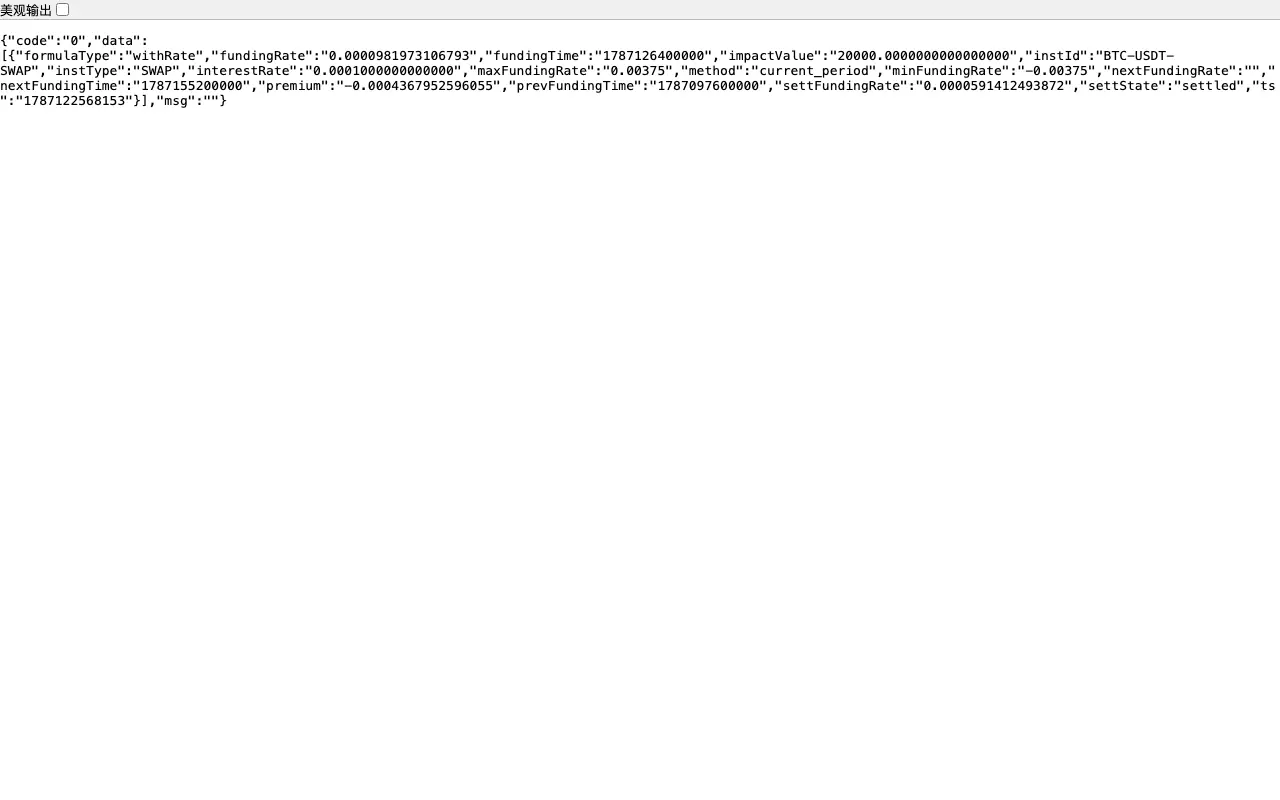
Source: OKX public endpoint GET /api/v5/public/funding-rate?instId=BTC-USDT-SWAP, captured August 19, 2026.
Funding, trading fees, and slippage are three different things
The full cost of one perpetual trade can include at least:
- The maker or taker fee on the opening fill;
- The fee on the closing fill;
- Funding paid or received across any settlement you hold through;
- Slippage from market orders or a thin book;
- Price movement itself, plus liquidation risk if margin runs short.
If maker, taker, and account fee tiers are still unclear, start with OKX fee tiers and how to check your rate; for "zero-fee" pairs, understand that zero commission does not remove spread cost. Funding is one component of total cost and cannot decide on its own whether a trade is worthwhile.
A six-point check before holding a position
- Confirm the contract. BTC-USDT perpetual and BTC-USD coin-margined perpetual are not the same instrument and may use different units.
- Read the current rate and countdown. Confirm whether this contract settles on an 8, 4, 2, or 1-hour interval.
- Estimate on position value. Do not multiply your margin; include the leveraged notional.
- Model several settlements. For an overnight or longer hold, run a few rate scenarios rather than assuming the current rate persists.
- Sum all costs together. Put the opening fee, estimated closing fee, funding, and likely slippage into one break-even figure.
- Keep margin headroom. Both funding and price movement change account equity; at high leverage, do not run available margin to the edge.
To fold funding into a single cost table with opening and closing fees and slippage, see calculating your OKX perpetual break-even price.
FAQ
How often does OKX charge funding: every 4 hours or 8 hours? Every 8 hours by default (00:00, 08:00 and 16:00 UTC), but individual contracts can run on 4, 2 or 1 hours, and the interval shortens automatically when the rate hits its cap or floor. The countdown on the trading page is authoritative.
If I open a position one minute before settlement, do I pay funding? Yes. What counts is whether you hold a position at the settlement time, not how long you've held it. A position opened just before settlement pays or receives the full period's rate.
Does OKX keep the funding fee? Per OKX's mechanism documentation, funding is exchanged between long and short holders and the platform does not retain it. Opening and closing trading fees are charged separately according to your tier and fill type.
Will I still pay funding for this period if I close my position? If you have fully closed before settlement, you generally do not participate in that funding settlement. Because processing spans a short window, it is unwise to rely on this in the final seconds. Your actual fill time and the funding record in your account statement are authoritative.
The rate did not change, so why did the amount? Because funding depends on position value at settlement. A change in contract quantity, mark price, or contract specification changes the amount.
Is a negative funding rate a guaranteed profit for longs? No. It only means shorts pay longs for that settlement. A falling contract price, slippage, and trading fees can easily exceed the funding received.
Where do I verify what was actually deducted? Filter for funding entries in your OKX account statement or transaction history, and line up settlement time, contract, position direction, position value, and the rate for that period. If it still does not reconcile, contact official support with public order information only — never share passwords, verification codes, API keys, or seed phrases.
Sources
- OKX: How are futures trading fees calculated?
- OKX: Perpetual funding fee mechanism
- OKX: Perpetual futures funding fee FAQ
- OKX: 2026 funding rate formula update
- OKX public API: BTC-USDT-SWAP current funding rate
Educational content only, not investment advice. Perpetual contracts are high-risk and leverage magnifies losses. Confirm local rules, product eligibility, and your own risk tolerance first.