OKX Fees 2026: Trading, Withdrawal and Funding Costs Explained
A practical guide to OKX fees in 2026: where to check your account-specific spot maker/taker rate, how futures costs differ from funding, and why crypto withdrawal fees vary by network.
Published Revised 7 min read
OKX spot fee schedule
| Tier | Maker | Taker | 30-day volume ≥ | or assets ≥ |
|---|---|---|---|---|
| Regular | 0.08% | 0.1% | — | — |
| VIP 1 | 0.0675% | 0.08% | $1,000,000 | $100,000 |
| VIP 2 | 0.06% | 0.07% | $5,000,000 | $200,000 |
| VIP 3 | 0.055% | 0.065% | $10,000,000 | $2,000,000 |
| VIP 4 | 0.03% | 0.045% | $20,000,000 | $5,000,000 |
| VIP 5 | 0.025% | 0.035% | $100,000,000 | $20,000,000 |
| VIP 6 | 0% | 0.03% | $200,000,000 | $50,000,000 |
| VIP 7 | -0.001% | 0.023% | $500,000,000 | $100,000,000 |
| VIP 8 | -0.0025% | 0.02% | $1,000,000,000 | $250,000,000 |
| VIP 9 | -0.005% | 0.015% | $5,000,000,000 | $500,000,000 |
As of Oct 14, 2026Source OKX official fee pageOKX global-site standard rates; EU, US and other regional sites differ. Either volume or assets qualifies
Estimate your fees per trade and per month
Perpetuals use USDT-margined rates. Add a holding time below to estimate funding.
- Per trade
- —
- Funding per position
- —
- Per month
- —
- Effective rate
- —
- Per trade
- —
- Funding per position
- —
- Per month
- —
- Effective rate
- —
Sign up through a referral link and both exchanges return 20% of your fees. At your volume:
OKXabout
Sign up on OKX OK6669Binanceabout
Sign up on Binance BNB6669OKX withdrawal fees for popular coins (cheapest network)
| Coin | Cheapest network | Fee | Minimum |
|---|---|---|---|
 USDT USDT | Plasma (USDT0) | 0.000006 | 2 |
 USDC USDC | X Layer | 0.0003 | 0.0004 |
 BTC BTC | X Layer | 0.00000001 | 0.0002 |
 ETH ETH | Robinhood Chain | 0.0000012 | 0.0002 |
 SOL SOL | X Layer | 0.000002 | 0.0002 |
 XRP XRP | XRP | 0.01 | 3 |
 TRX TRX | Tron (TRC20) | 1.2 | 22 |
 DOGE DOGE | Dogecoin | 4 | 14 |
The full guide
Last verified: September 14, 2026. This independent educational guide is not affiliated with OKX and is not financial, legal or tax advice. Products, fee schedules and eligibility vary by account and jurisdiction. Check the rate shown inside your own account before placing an order.
OKX fees are not one universal percentage. A spot trade, a futures position and a crypto withdrawal are three different actions with different cost rules. Your actual charge can also depend on the trading pair, how the order fills, your fee tier, the selected network and the OKX entity serving your region. This guide shows what to check, how to estimate the cost and which screen should be treated as the final source of truth.
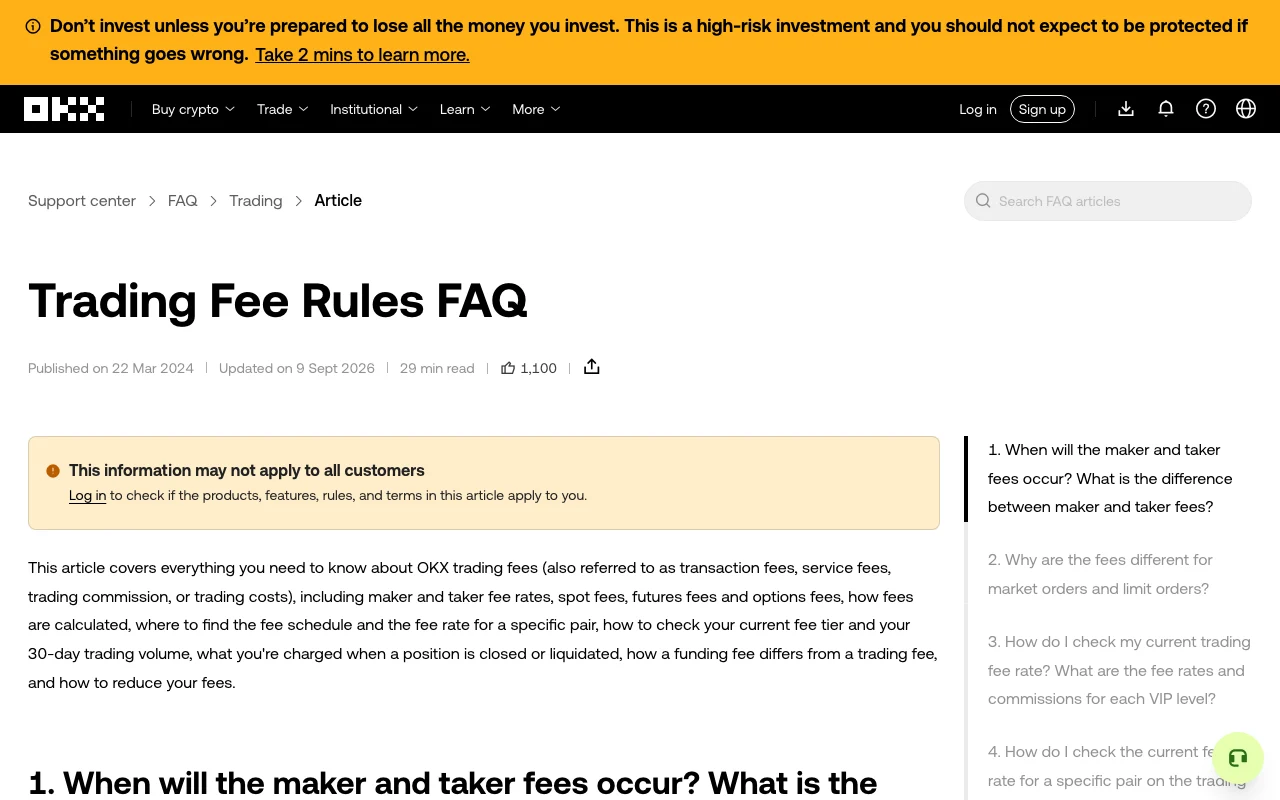
Real screenshot of the public OKX Trading Fee Rules FAQ, captured September 14, 2026. No account or personal data is shown.
OKX fees at a glance
| Action | What normally determines the charge | Where to verify it |
|---|---|---|
| Spot order | Filled amount, maker/taker execution, pair and account tier | The Fees area on that pair's order panel and the fee page in your signed-in account |
| Futures order | Contract value or quantity, execution price, maker/taker rate and contract type | The selected futures market's fee display and your account fee page |
| Perpetual funding | Position value and the funding rate at the settlement time | The contract's current and predicted funding information |
| Crypto withdrawal | Asset, network and the fee displayed for that withdrawal | The final withdrawal review screen |
| Express Buy/Sell or Convert | The all-in quoted price and spread rather than only an order-book commission | The quote and confirmation screen |
The practical rule is simple: identify the action first, then read the fee shown for that exact product and account. A percentage copied from another user, country or old screenshot may be accurate for them and still be wrong for you.
Spot fees: maker and taker depend on execution
OKX's Trading Fee Rules FAQ says a maker order adds liquidity by resting on the order book before it fills. A taker order removes liquidity by matching an order already available. The fee follows the actual execution, not merely the label on the order form.
A market order will usually be a taker because it is designed to execute immediately. A limit order is not automatically a maker: if its price crosses the book and fills at once, that fill can be charged as taker. If it rests and is matched later, it can be maker. Partial fills can also produce several fee records under one order.
The official FAQ uses a Level 1 BTC/USDT example with a 0.08% maker rate and a 0.10% taker rate. Treat those figures as an explanatory example, not a universal promise. OKX states that the applicable rate can differ by instrument, fee tier and region. For a closer explanation of tiers and execution, read our OKX maker/taker and fee-tier guide.
A simple spot-fee estimate
For a rough estimate before a spot fill:
estimated trading fee = filled amount × applicable fee rate
If a 1,000 USDT-equivalent fill used a 0.10% example rate, the fee-equivalent calculation would be 1 USDT. That demonstrates the scale only. The actual fee currency can follow the side of the trade: on a spot buy, the fee may be taken from the crypto received; on a sell, it may be taken from the proceeds. The completed fill record is more authoritative than this estimate.
Also separate the explicit fee from execution cost. The bid-ask spread and slippage can change the average fill price, so a lower commission does not guarantee a cheaper result. A pair advertised with a 0% trading fee can still have spread and price movement.
How to find the rate that applies to your account
OKX's current FAQ gives two useful checks:
- Open the trading page for the exact spot or futures instrument and find Fees in the order-placement panel. It can show the maker and taker rates applying to that pair.
- In the app, open the selected trading market, then use More → Fee rules to review the level and rate for that instrument.
Menu wording can change, and some products are unavailable in some jurisdictions. If the public schedule, an article and the signed-in trading screen disagree, pause and use the signed-in rate plus the final order confirmation. After execution, open order history and inspect the fee on the individual fill.
Futures fees: include opening, closing and funding separately
A futures position can create more than one cost. Opening and closing are separate executions, so each can have a trading fee. Perpetual contracts can also exchange funding between long and short holders at a funding settlement time. Funding is not the same as a maker/taker trading fee, and OKX says it does not take a service fee from that exchange between holders. Liquidation-related costs may also apply.
OKX documents different formulas for USDT-margined and crypto-margined futures. For USDT-margined futures, its published structure uses contract value, number of contracts, execution price and the applicable fee rate. Crypto-margined contracts use a different calculation. This is why a spot formula should not be copied into a derivatives estimate.
Leverage does not reduce the fee basis to the cash margin you posted. A relatively small margin can control a larger position, while trading fees relate to the contract or position value. Before opening a leveraged trade, estimate both sides of the trade, possible funding and likely slippage. Our OKX futures break-even cost guide walks through that calculation.
Withdrawal fees: check the asset and network
A crypto withdrawal fee is separate from trading commission. OKX's deposit-and-withdrawal help page says the receiving OKX account is not charged a crypto deposit fee, while the withdrawing party pays the withdrawal fee. It also says the displayed withdrawal amount can vary with the network, operational costs, congestion and fee adjustments.
The withdrawal fee is generally shown before submission and is charged per withdrawal transaction rather than as the spot trading rate. Do not choose a network only because it displays a lower fee. The destination must support the same asset on the same network, including any required memo or tag. A network mismatch can lead to delayed crediting or loss. For a focused checklist, see our OKX withdrawal fee and network guide.
Before confirming a withdrawal:
- verify the destination address and network independently;
- confirm any memo or tag;
- read the displayed fee and net amount;
- check the platform's minimum withdrawal and the destination's minimum deposit;
- send a small test transfer when using a destination for the first time, if practical.
An all-in cost checklist
Before a spot or futures order, record these items instead of looking only at the headline rate:
- the exact pair or contract;
- maker and taker rates shown for your account;
- whether the order is likely to rest or execute immediately;
- the bid-ask spread and available depth;
- expected slippage for the order size;
- opening and closing fees for a futures plan;
- possible perpetual funding during the intended holding period;
- any later withdrawal fee and network compatibility.
Avoid trading merely to reach a higher tier. The additional turnover and market risk can cost more than the discount. Likewise, a referral or promotional page should not be treated as a guaranteed fee quote: eligibility, duration and regional terms can change.
Deeper guides for each OKX fee type
- OKX fee tiers: maker vs taker and how to check your actual rate
- How to calculate OKX trading fees, with worked examples
- Are OKX spot fees charged per order or per fill?
- OKX zero-fee pairs: what the spread still costs
- OKX futures fees and perpetual break-even cost
- OKX funding rate vs trading fees
- OKX withdrawal fees and how network choice changes them
- Does OKX charge deposit fees?
- OKX fee discounts ranked by reliability
- OKX vs Binance fees: how the two fee systems differ
Frequently asked questions
Are OKX spot fees always 0.08% maker and 0.10% taker?
No. Those figures appear in OKX's official Level 1 BTC/USDT example, but the rate applying to you can differ by region, instrument, pair and account tier. Check the selected market while signed in.
Is every limit order charged the maker rate?
No. A limit order that immediately matches the book can be a taker. Maker or taker treatment depends on how each fill executes.
Are futures trading fees and funding the same?
No. Opening and closing fills can each incur a trading fee. Perpetual funding is a separate exchange between long and short position holders at the applicable funding time.
Does OKX charge the same withdrawal fee on every network?
No. The available networks and displayed fee depend on the asset, region and current platform rules. Always use the fee shown on the final withdrawal screen.
Does zero trading fee mean zero cost?
No. A 0% maker/taker fee does not remove the bid-ask spread, slippage, conversion cost, funding or a later withdrawal fee.
Bottom line
For spot trading, verify the selected pair's maker and taker rates and inspect the completed fill. For futures, add opening, closing and possible funding instead of using a spot-only estimate. For withdrawals, treat the asset-and-network confirmation screen as the operative quote. That process is more reliable than relying on one percentage from a search result.
Official sources
- OKX Trading Fee Rules FAQ — maker/taker definitions, pair-level rate checks, fee payment and additional costs; updated September 9, 2026.
- OKX: How are futures trading fees calculated? — USDT- and crypto-margined formulas and common futures costs; updated August 26, 2026.
- OKX: Do I need to pay fees for deposit and withdrawal? — deposit and withdrawal fee mechanics; updated August 5, 2026.
Educational content only. Crypto trading and leveraged derivatives carry risk, and product availability varies by jurisdiction.