
Guides
Binance Futures Fees Explained: How Trading Fees and Funding Are Calculated
Binance futures fees are charged on position value, not margin, on both opening and closing. This guide covers the official formulas, maker vs taker, funding payments, VIP tiers and the BNB discount.
Last verified: September 27, 2026. This independent educational guide is not affiliated with Binance and is not financial, legal or tax advice. Futures and leveraged products carry a high risk of loss and are not available in every jurisdiction. Fee rates change over time. Always check the rate shown for your own account.
Binance futures costs are easy to underestimate. The fee rate looks tiny, but it is charged on the full position value, not on the margin you put up. It is also charged again when you close. And a perpetual position held across a funding time can pay or receive funding, which Binance does not count as a trading fee at all.
This guide breaks those costs apart, shows the formulas Binance publishes and gives you a quick way to estimate the total cost of a trade before you place it.
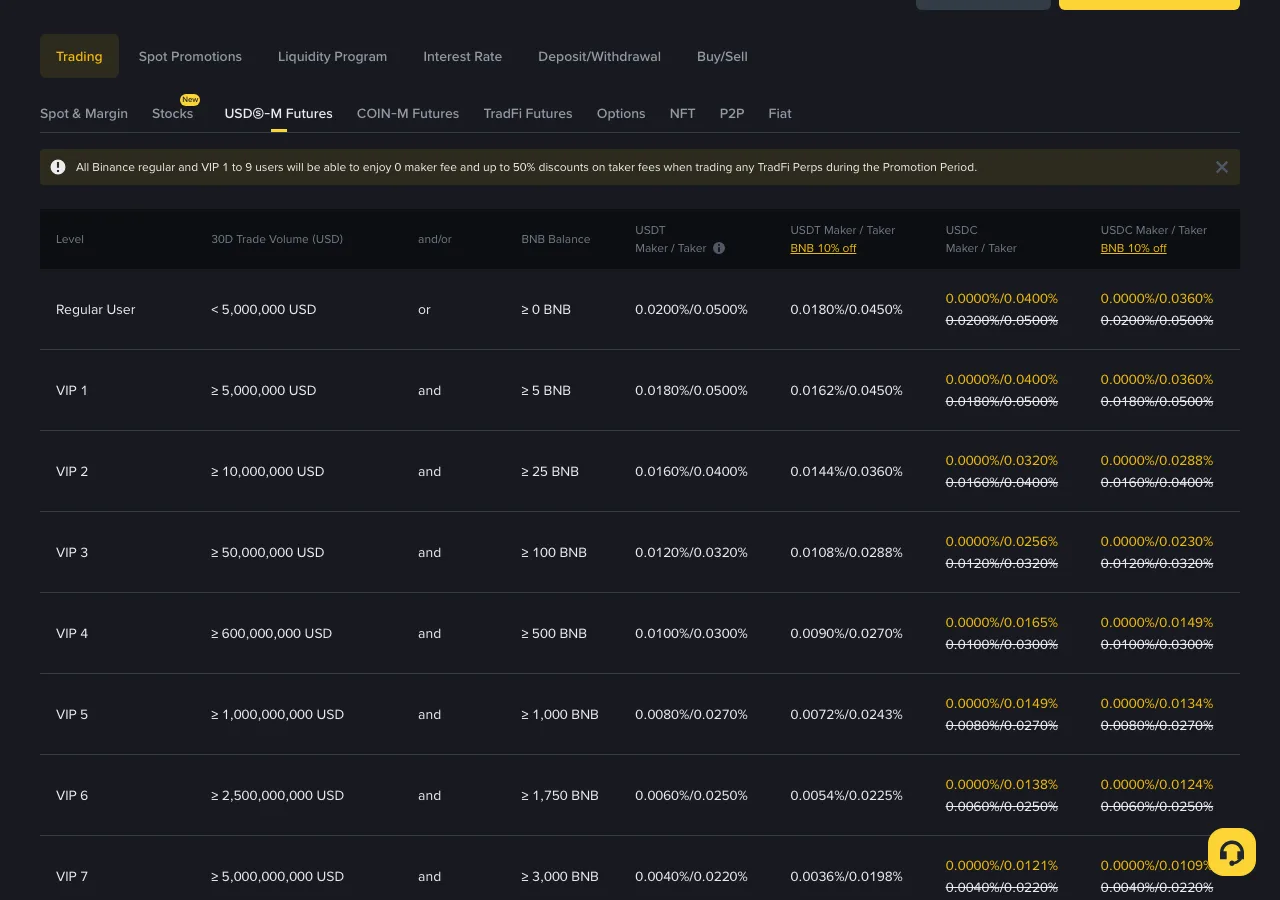
Binance's public USDⓈ-M Futures fee table, captured September 27, 2026, signed out. The rates and promotions shown belong to Binance and change over time, so use the live page or your account for current figures.
The costs in a Binance futures trade
A single round trip on a Binance perpetual contract can involve several separate costs:
| Cost | When it applies | Who receives it |
|---|---|---|
| Opening trading fee | When your opening order fills | Binance |
| Closing trading fee | When your closing order fills | Binance |
| Funding payment | Only if you hold a position at a funding time | The traders on the opposite side |
| Spread and slippage | Whenever an order fills at a worse price than expected | Not a fee, but a real cost |
Liquidation can add further costs under Binance's liquidation rules. The simplest protection is to size positions so that liquidation stays far away.
How Binance calculates futures trading fees
Binance's FAQ on futures fees gives one formula for both contract types, with a different definition of position value:
- USDⓈ-M contracts: Trading fee = Position value × fee rate, where position value = contract size × execution price. The fee is in the margin asset, such as USDT.
- COIN-M contracts: Trading fee = Position value × fee rate, where position value = (number of contracts × contract multiplier) ÷ execution price. The result is in the underlying coin, such as BTC.
The key point is that position value is the notional size of the trade, not your margin. With 10x leverage, 1,000 USDT of margin controls a position worth about 10,000 USDT. The fee is charged on the 10,000.
Illustrative example (hypothetical rate, not a quote): you open a 10,000 USDT BTCUSDT position with a market order. If your taker rate were 0.05%, the opening fee would be 10,000 × 0.05% = 5 USDT. Closing the same size with another market order at a similar price would cost roughly another 5 USDT. The round trip costs about 10 USDT, which is 1% of your 1,000 USDT margin, before funding or slippage.
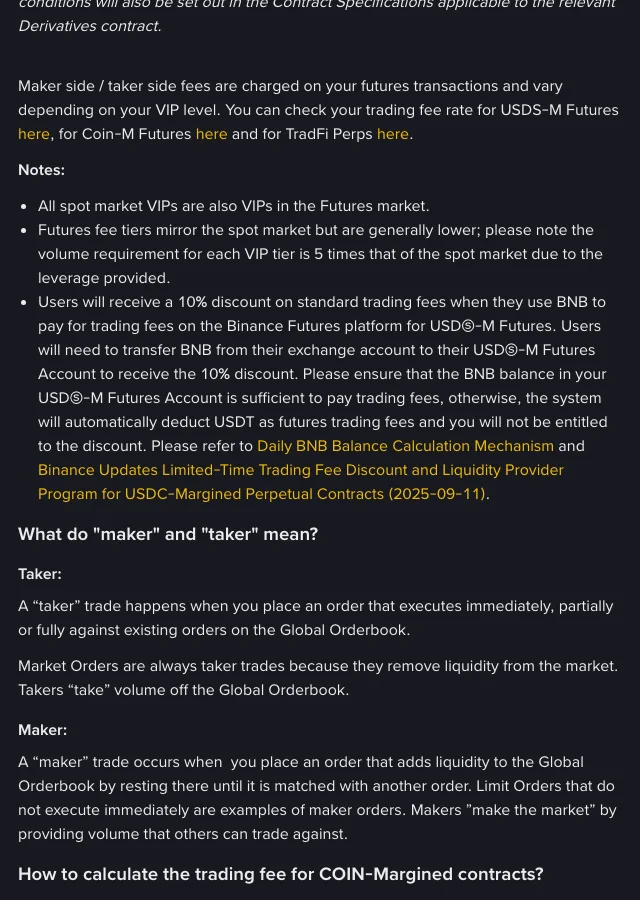
Binance's futures fee FAQ, captured September 27, 2026. Page updated May 1, 2026.
Maker vs taker on Binance futures
Your rate depends on whether each fill is a maker or a taker trade. Binance defines them this way:
- Taker: an order that "executes immediately, partially or fully" against orders already on the book. Market orders are always taker trades.
- Maker: an order that rests on the order book until another order matches it. A limit order that does not fill immediately is a maker order.
A limit order is not automatically a maker order. If its price crosses the book and it fills straight away, that part is a taker fill. For an explanation of order types, see our beginner's guide to limit, market and stop orders.
Funding is not a Binance fee
Perpetual contracts have no expiry, so exchanges use funding payments to keep the contract price close to the index. On Binance:
- Formula: Funding amount = Nominal value of positions × Funding rate, where nominal value = mark price × contract size.
- Timing: you only pay or receive funding "if you have open positions at the pre-specified funding times". The default interval is every 8 hours at 00:00, 08:00 and 16:00 UTC. Some contracts use different intervals, and Binance can change them in volatile markets. Check the contract's live funding countdown.
- Direction: when the rate is positive, long positions pay short positions. When it is negative, shorts pay longs.
- Not a Binance charge: Binance states that it "does not charge fees on Funding Payments", which are "transferred directly between traders holding opposing positions".
Funding can be larger than trading fees for positions held over several days, so include it in any cost estimate. We explain the same mechanism on another exchange in funding rate vs trading fees.
VIP tiers and the BNB discount
Two points from Binance's futures fee FAQ decide which rate you get:
- VIP levels are shared with spot. "All spot market VIPs are also VIPs in the Futures market." Futures tiers mirror spot but are generally lower, and Binance notes the futures volume requirement for each tier is five times the spot requirement.
- BNB discount on USDⓈ-M futures. Binance offers a 10% discount on standard trading fees when BNB pays the fee. The BNB must be in your USDⓈ-M futures account. If the balance there is not enough, Binance deducts the fee in USDT and you do not get the discount. Binance's Chinese-language version of the FAQ also notes that BNB in the futures wallet only offsets trading fees. It cannot pay liquidation-related fees or serve as margin.
How BNB fee payment works on the spot side is covered in how to reduce Binance trading fees.
Estimate your total cost before you trade
Use this worksheet with the rates shown in your own account:
- Position value = size × entry price (USDⓈ-M).
- Opening fee = position value × your maker or taker rate.
- Closing fee = position value at exit × the rate for your closing order.
- Funding = nominal value × funding rate, for each funding time you hold through. It can be positive or negative.
- Buffer for slippage, especially on market orders in fast markets.
Add steps 2 to 5 and divide by the position value. That gives the percentage move you need just to break even. Our perpetual break-even calculation guide walks through the same method with a full worked table.
Frequently asked questions
Are Binance futures fees charged on margin or on position size?
On position size. Binance's formula uses position value, which is contract size × execution price for USDⓈ-M contracts. Leverage raises the fee relative to your margin.
Do I pay fees on both opening and closing?
Yes. Each fill is charged at the applicable maker or taker rate, so a round trip pays fees twice.
Is the funding rate a fee Binance keeps?
No. Binance says funding payments pass directly between long and short holders and that it does not charge fees on them.
Will I pay funding if I close before the funding time?
Binance says you are only liable for funding if you hold an open position at the funding time.
Does the BNB discount apply automatically?
Only if BNB fee payment is in use and enough BNB sits in your USDⓈ-M futures account. Otherwise, the fee is deducted in USDT at the standard rate.
Official sources
- Binance: Futures Fee Structure & Fee Calculations: formulas, maker/taker definitions, VIP and BNB rules; updated May 1, 2026.
- Binance: USDⓈ-M Futures Trading Fee Rate: live fee table by level; checked September 27, 2026.
- Binance: Introduction to Binance Futures Funding Rates: funding formula, intervals and payment rules; updated March 6, 2026.
Educational content only. Leveraged derivatives can lose more than you expect in a short time. Only trade with money you can afford to lose.